
Blog

Explore articles and insights on navigating life transitions, ADHD, and personal growth

Building Self-Confidence: Break Negative Patterns with Small Shifts

Building Self-Confidence and Breaking Negative Patterns 

Have you ever felt stuck in the same old loops, thinking the same thoughts, reacting in the same ways, and wondering why it’s so hard to move forward? Those are negative patterns at work. That little voice in your head saying, “I’ll never be good enough,” or maybe you downplay the success you have had as “luck” instead of acknowledging your own hard work (hello imposter syndrome!).  Many therapies can help with Imposter Syndrome, especially if it’s a recurring pattern in your life. Rapid Transformational Therapy is one approach that works at a deep subconscious level to break these patterns and build lasting confidence.

These patterns can sneak in slowly, shaping how you see yourself and what you believe is possible. Over time, they chip away at your confidence, keeping you stuck in a cycle of doubt. The thing is, these patterns don’t define you, and they’re not permanent. They can be broken. When you start shifting your mindset, even in small ways, you can build self-confidence that feels real, not forced.

A great way to begin changing these thought loops is through meditation. You can claim a free one below to help you get started!

GRACE: Your Guide to Breaking Patterns

When this happens I like to remind myself of GRACE: Gratitude, Reflection, Alignment, Connection, and Embracing small habits.

Following these steps, using the word GRACE as a reminder for each one, helps you replace those negative loops with something stronger, kinder, and more aligned with the person you’re becoming.

G – Gratitude Shifting Your Focus

Negative patterns tend to zero in on what’s missing or what’s wrong. Gratitude is the antidote. It’s not about pretending everything’s perfect; it’s about noticing the good, even in the messy moments.

One thing I do is keep a gratitude jar. Each day, I write one thing I’m thankful for on a post-it note and drop it in the jar. It could be something as small as a quiet morning with a cup of tea or something big like overcoming a challenge.

When I am feeling low, or have not been talking to myself the way I would a friend, I pull one out, and it’s like a little reminder of how far I’ve come.

If a jar doesn’t feel like your thing, just jotting it down in a notebook works too.

Reflection: Recognising the Patterns

Breaking free from old patterns starts with understanding them. Journaling is a great way to spot what’s holding you back. Take a few minutes to write about a situation that felt tough recently, what were you thinking or feeling at the time?

You might notice a recurring thought, like, “I always mess things up.” That’s the pattern. Once you’ve recognised it, try reframing it. Instead of, “I always mess things up,” you might write, “I’m learning from my experiences, even when things don’t go perfectly.”

Journaling isn’t about being perfect on the page; it’s about giving yourself a space to explore, process, and start to shift the way you think. If you want to explore self-reflection and how it supports personal growth, you might find Achieving Your Goals: The Role of Reflection helpful.

Woman reflecting into a mirror on sandy ground

Alignment: Stepping Into Your Future Self

Visualisation is one of the most powerful ways to interrupt negative thought patterns and create something new. Close your eyes and imagine yourself at your most confident. Where are you? What can you hear or smell? Maybe it’s the scent of fresh coffee in your dream workspace, or the sounds of nature on a peaceful walk.

Now focus on how it feels to be that person, calm, confident, or energised. Let yourself sit with those feelings. This isn’t about wishful thinking; it’s about connecting with the version of you that already exists deep down.

The more you practise visualising with sensory details, the more real it starts to feel, and you will find that you start to make choices that align with that version of you.

Connecting your body and mind with Movement

When negative patterns weigh you down, even small movements can help shift your mindset. A short walk, a stretch, or even a couple of minutes dancing around the kitchen can shake off that stuck feeling.

Movement creates momentum, it reminds you of what your body can do and helps you break out of that mental fog.

You don’t need a strict routine or fancy gear, just find what feels good in the moment.

Embracing Small Habits

Big changes start with small, consistent actions. It’s not about overhauling your entire life in one go, it’s about finding one thing you can do differently today.

Maybe you decide to start your morning with a deep breath and a clear intention, like, “Today, I’ll focus on what I can control.” Or you add a few minutes of journaling to your evening routine.

These tiny shifts might not seem like much at first, but over time, they create ripples that can transform how you see yourself.

If you’re ready to shift those old patterns, remember GRACE:

  • Gratitude to notice what’s good.
  • Reflection to understand and reframe negative thoughts.
  • Alignment with your future self through visualisation.
  • Connection with your body and mind through movement.
  • Embracing small habits to create momentum.

Self-confidence isn’t something you wake up with one day—it’s something you build, step by step.

Each time you challenge a negative thought or take a small action, you’re proving to yourself that change is possible. You’ve got this.

Overcoming Perfectionism – Letting Go and Living Fully

Overcoming Perfectionism – Letting Go and Living Fully

Growing Up with the Pressure to Be Perfect

Some people might wonder – why is overcoming perfectionism important? Isn’t it a good thing to strive for the best?

For those of us in Gen X, and even some older Millennials, we grew up in a world that told us being perfect was the ultimate goal. The perfect score, the flawless A-star report card, excelling at everything we tried, these were the measures of success.

The Exhausting Ideal of ‘Having It All’

And it wasn’t just about achievements. As women, we were told we could have it all, the career, the looks, the partner, the money, the holidays, the beautiful children, and the picture-perfect home.

Even writing it all down feels exhausting, let alone trying to juggle everything and live up to some imagined ideal, no doubt shaped by watching TV shows where someone managed to do it all and make it look effortless.

Why Overcoming Perfectionism Matters

And that’s exactly why we need to break free from the perfectionist cycle. We are exhausted!  Luckily, things are starting to change. Schools and workplaces have begun to realise that putting this kind of pressure on young people isn’t helpful, and they’ve adapted the way they teach, grade, and reward success.

But for those of us who grew up in the 70s, 80s, and 90s, that pressure runs deep. The belief that our worth is tied to our achievements is hard to shake, and we continue striving, pushing, and measuring ourselves against an impossible standard.

What Is Perfectionism, Really?

Perfectionism is often defined as the relentless pursuit of flawlessness, accompanied by excessively high standards and an overly critical self-evaluation. But here’s the truth, perfection, by its very definition, is practically impossible to achieve.

And yet, we chase it. We believe that if we can just do everything right, life will fall into place. But perfectionism doesn’t lead to happiness; it leads to stress, anxiety, and feeling like we’re never quite enough.

It can show up in so many ways, procrastinating because you’re afraid of doing something wrong, avoiding opportunities because you’re scared of failure, or constantly feeling like your efforts aren’t good enough, no matter how much you achieve.  So, how do we begin to break free from perfectionism and embrace a life that feels more balanced and fulfilling?

Woman holding up her hand in a stop gesture

The PAUSE Method: 5 Steps to Letting Go of Perfectionism

When I talk about overcoming perfectionism, I don’t mean giving up on your goals, goals are crucial, nor should you lower your standards. What I do mean is that we need to create a more balanced and realistic approach to life, one that allows space for mistakes, growth, and self-compassion.

That’s where PAUSE comes in a simple way to remind yourself to take a step back and approach life with more kindness and flexibility. Setting goals that are adaptable and achievable can help you make progress without feeling like every misstep is a failure. If you’re looking for a better way to set goals that support your success, check out my blog on Ditching Resolutions and Setting Goals for Lasting Success.

P – ‘Permit’ Yourself to Be Imperfect

Perfectionism thrives on the idea that mistakes equal failure. But mistakes are how we grow and learn. Give yourself permission to be imperfect, to try, and to not get everything right the first time.

When you find the inner critic (the voice in your head) start to berate you, instead of listening reframe your thoughts.

Swap phrases like “I should have done better” with “I did my best with what I knew at the time.” By letting go of the idea that everything has to be perfect, you open yourself up to new opportunities and experiences.

A – ‘Accept’ Progress Over Perfection

One of the biggest struggles with perfectionism is feeling like if it’s not perfect, it’s not worth doing. But progress is always better than perfection. Taking small, imperfect steps is far better than staying stuck in fear of not getting it “just right.”

Set small, achievable goals and celebrate your wins, no matter how small they seem. Remind yourself that done is better than perfect, and every step forward is a step in the right direction.

U – ‘Understand’ Your Triggers

Perfectionism is often driven by experiences and expectations, whether from childhood, work environments, or social media comparisons. Understand what those triggers are and reflect. Is it pressure from others? Fear of judgment? A desire for control?

Recognising these triggers can help you take a step back and challenge them, rather than letting them dictate your actions.

S – ‘Show’ Yourself Kindness

We can be so hard on ourselves, constantly pushing, criticising, and comparing. But treating yourself with kindness is one of the most powerful ways to break the perfectionism cycle.

Start by noticing how you talk to yourself. If your inner critic is harsh, ask yourself: “What would I think of a friend who said this to me? And would I say this to a friend?”

If the answer is no, it’s time to change the script. Practising self-compassion means allowing yourself to struggle, to take breaks, and to acknowledge that you’re doing your best

E – ‘Embrace’ Flexibility

Perfectionism is rigid and unforgiving, but life isn’t meant to be lived that way. Learning to embrace flexibility allows you to adapt when things don’t go according to plan, and still feel good about it.

Instead of focusing on strict goals or expectations, try being open to different outcomes. Flexibility gives you the freedom to enjoy the journey rather than feeling tied to a single destination.

Moving Forward with PAUSE

Breaking free from perfectionism isn’t about giving up, it’s about living in a way that feels more aligned with who you are, not who you think you should be.

By giving yourself permission to be imperfect, accepting progress, understanding your triggers, showing kindness, and embracing flexibility, you can create a healthier, more fulfilling way of living.

How to STOP Overthinking: Tips, Techniques and Strategies

How to STOP Overthinking: Tips, Techniques and Strategies

As a counsellor and coach, I often hear clients asking me how to stop overthinking. Clients describe overthinking as a constant barrage of negative thoughts racing through their minds, the sound of continuous chatter, or playing out past and future scenarios, all with different endings. This blog will provide tips, techniques, and strategies to help you stop overthinking in its tracks, providing you with the calmness your body and mind need.

Constant intrusive thoughts can make people anxious and stressed, impacting how they feel during the day. They can also cause sleepless nights, which can take its toll on a person’s mental health. Overthinking can feel like a relentless cycle of destructive thought patterns and catastrophic predictions that refuse to switch off or quiet down. If you experience this level of overthinking, you know how exhausting it can be.

I often liken overthinking to going on an emotional roller-coaster; you repeatedly experience the emotions attached to events that your mind creates. You have been on this emotional journey but haven’t been anywhere apart from trapped in an endless cycle of anxious thoughts.

Let’s examine the triggers, mental and physical symptoms, and tips and strategies for conquering negative thinking patterns.

What Triggers Overthinking?

Understanding what triggers overthinking can be revealing. This insight can help you achieve a more calming and peaceful mind and lead you to personal growth.

Notice how overthinking tends to start for you. It is triggered by;

  • An event or situation that you find stressful
  • A sudden recollection of past events that has made you feel embarrassed or not good enough?  An assumption based on how you perceive the actions of others
  • The fear of confrontation or upsetting another person

For example, it could be a sideways glance from a friend, the tone of a work email, or an unanswered WhatsApp message. Thoughts can quickly escalate and result in running different conversations through your mind, with different endings; usually, these thoughts have worst-case scenario outcomes.

When you notice the triggers, the next time you end up overthinking, you can remind yourself that it is just a thought, not a fact. You can then decide what you would like to do with the idea. Is there some problem-solving to do? How does the thought make you feel? Can you describe the feeling and name it? Cognitive behavioural therapy (CBT) is a therapy that can help with reframing thoughts. The premise of CBT is that thoughts, feelings, and behaviours are all interlinked.

The Downside of Overthinking

Overthinking, catastrophising, and trapping yourself in negative thought patterns prevent you from living in the present moment. Getting into the vicious cycle of overthinking can impact your daily life. Research demonstrates overthinking can be responsible for issues which include:

  • Mental Health Conditions
  • Isolation
  • Sleep Issues
  • Procrastination
  • Low confidence and low self-esteem
  • Headaches, muscle tension and digestive problems

This physical and mental toll is a stark reminder of the need to address overthinking. However, the million-dollar question is, what is the best way to free yourself from overthinking?

Breaking Free from Overthinking

Breaking free from overthinking isn’t just about pushing away your thoughts. It’s about taking control, changing your relationship with these persistent thoughts, and finding alternative ways to manage them.

An excellent place to start is to recognise how overthinking affects you. Notice the mental and physical symptoms and reflect on how they impact other areas of your life, such as interacting with others, progressing in the workplace, or procrastinating. Then, flip this on its side: If you didn’t overthink, what would life look like then? This part is essential as it serves as the driver for you to beat overthinking.

Reflecting on your thoughts may seem counterproductive, as it involves more thinking! However, stay with me. Overthinking can sometimes be helpful, but you must find better ways to manage your overthinking habits, which we will discuss later in this blog.

Reviewing the past and planning the future can be helpful. However, it is essential to enjoy the here and now rather than getting caught up in a spiral of “what ifs”, “could haves “, and “should haves.”

Overthinking and The Red Car Theory?

The Red Car Theory suggests that when you focus on something, you start noticing it everywhere. For example, if you think about a red car, suddenly, it seems like they’re all over the road. In reality, the number of red cars hasn’t increased, your brain is just more tuned in to them because they’re at the forefront of your mind. Everything else fades into the background as your attention locks onto what you’re looking for.

This theory highlights how selective attention shapes our perception. When you overthink, your mind fixates on certain thoughts, making them feel overwhelming and ever-present. Recognising this can bring relief, helping you step back and see the bigger picture.

Case Study: How the Red Car Theory Fits with Overthinking

Emma’s colleague Tom comes into work one day and is unusually quiet. Emma notices Tom doesn’t smile when he sits down and doesn’t speak for most of the morning.

Emma started thinking about what she could have done or said to upset him. Was it the last email she sent? Did it sound curt rather than friendly? Emma revisited past situations in her mind, such as the time she forgot to hand over an important document and the time she missed a necessary appointment.

Emma concludes that she has made Tom angry, which must be related to her incompetence. She remembers other times when Tom was quiet and believes he doesn’t like working with her.

With these thoughts going through her mind, Emma struggles to focus on her work. She becomes aware of other colleagues around her interacting with each other, making her feel more alone and unpopular. These thoughts confirm to Emma that Tom doesn’t like her, that she is unpopular in the office, and that she HAS evidence of this.

What is Confirmation Bias?

However, the reality of this situation is likely to be quite different. There could be several reasons why Tom was quiet; he may have had bad news before coming into the office, missed the earlier train he intended to catch, or had a difficult night’s sleep. Similarly, Emma’s colleagues often chat and interact with each other; this isn’t unusual as they sit next to each other and must interact within their roles.

This example demonstrates confirmation bias, which occurs when you seek information to support your thoughts and disregard any other information that does not fit the story you are telling yourself. Confirmation bias can impact decision-making and your perception of situations and events.

Practical Steps to Overcome Overthinking

Overcoming the relentless noise of overthinking involves a multifaceted approach. As a Pluralistic Counsellor, there is no one-size-fits-all approach; it’s more about trying different techniques until you discover what works best for you.

Below is a range of self-care techniques known to help with overthinking. Trying different techniques can take time, but investing time in yourself is the first positive step.

  • Breathing Exercises:

    Deep breathing exercises are a great way to stop overthinking. You can try many different breathing exercises, including the Square Breathing Technique, which will help slow down your heart rate, make you feel more relaxed, and give you mental clarity.

  • Keeping a Gratitude Journal:

    Every day, spend a few minutes writing down what you are grateful for, or if you do it in the evening, write about what you have been thankful for during the day. It can be something that would typically go unnoticed, such as the beauty of nature around you, the brief interaction you had on your morning commute, or ticking jobs off your ‘to-do’ list. If you would like more information on the benefits of journalling, you might like my blog.

  • Body Scan Meditation:

    Get comfortable and focus your attention on different parts of your body. Begin with your toes and move upwards, noticing any areas of tension or discomfort. This exercise brings an awareness of the present moment and highlights how overthinking can impact physical health.

  • Mindfulness Meditation Practices:

    Pick up a small object and hold it in your hand.   Set a timer for five minutes and adequately focus on this object. How does it feel? Move your hand over the different textures, take in every detail, how it smells, and look at the colours. If thoughts come into your mind, just let them go and bring yourself back to looking at the object as soon as you notice them.

  • Physical Activity:

    When you exercise, your body releases many hormones that make you feel good, such as endorphins, serotonin, and dopamine. Exercise can be anything from a brisk walk to gentle exercise, team sports, or a gym workout. Choose whatever works best for you.

  • Allocate Time to Reflect:

    It can help to observe a thought mindfully rather than pushing it away. Accept the thought without judgment; write it down or do some problem-solving. A good tip is to allocate a time limit to reflect on thoughts during the day; often, when you reflect on them at a different time, they may feel insignificant, and you can let them go.

These techniques will help you stay in the present and offer you peace and tranquillity while your focus is only on what you are doing. The good news is that you will feel empowered by taking control of your mind, knowing you prioritise your mental health and overall well-being.

Close-up of running trainers, illustrating how exercise can alleviate overthinking.

When Overthinking Can Be Helpful

Overthinking often carries negative connotations, and if you identify as an overthinker, you might have heard comments like:

  • ‘It’s not that complicated. What’s your gut telling you?’
  • ‘You’re spending too much time thinking about this.’
  • ‘Are you still dwelling on this? Why not make a decision?’
  • ‘I can see this situation is stressing you; you’re overthinking it.’

Overthinking frequently stems from a fear of making the wrong decision. However, there’s often no definitive right or wrong choice; we must decide based on the information available. This is where problem-solving becomes a powerful tool, helping to identify actionable steps toward the best possible outcome.

In his article, ‘In Defence of (Over) Thinking,’ SuddhaSatwa GuhaRoy (2024) discusses how overthinking can be beneficial, particularly in academic research, problem-solving, or making significant life decisions. He suggests setting aside time to engage with recurring thoughts mindfully. Allocate time to sit with these thoughts; some may not require further consideration, while others might benefit from structured problem-solving. By taking this approach, you can determine the necessary steps to address specific concerns.

To Conclude

You don’t have to live a life filled with constant worry. Overthinking doesn’t define you, and with the right strategies, you can regain clarity and confidence in your decisions. Exploring the root cause of overthinking, whether it’s self-doubt, perfectionism, or low confidence, can help you break free from the cycle. As you strengthen your decision-making skills, you’ll naturally build self-trust, boost your self-esteem, and reduce the urge to overthink.

Many of these strategies can be effective on their own or with the support of a trusted friend. If you’d like extra guidance, professional support can help you move forward with greater clarity and self-awareness.

If you recognise that overthinking often comes with racing thoughts, distractibility, or emotional overwhelm, you may find my ADHD-informed courses designed to support focus, calm, and confidence.

Further Reading:

Nickerson, R. S. (1998). Confirmation Bias: A Ubiquitous Phenomenon in Many Guises. Review of General Psychology, 2(2), 175–220. https://doi.org/10.1037/1089-2680.2.2.175

Rensink, R. A. (2000). The Dynamic Representation of Scenes. Visual Cognition, 7(1-3), 17-42. https://doi.org/10.1080/135062800394667

GuhaRoy, S. (2024). In Defence of (Over)Thinking. Think, 23(67), 21–26. https://doi.org/10.1017/S1477175623000441

8 Tips to Stop Being a People-Pleaser

8 Tips to Stop Being A People-Pleaser

Do you find yourself agreeing with others, even when it goes against your own values or feelings? Do you want to say no or share your opinion, but somehow, you never do? If this sounds familiar, you may have people-pleasing tendencies or identify as a chronic people-pleaser.

The key difference is frequency and impact. If you occasionally put others first, your people-pleasing may be situational. But if you consistently prioritise others at the expense of your own well-being, people-pleasing may have become a deeply ingrained habit.

People-pleasing is often linked to the ‘fawn’ response, a term introduced by Pete Walker. This response describes people-pleasing as a survival mechanism, where individuals prioritise others’ needs to maintain safety and avoid conflict. While it can create a sense of security, it often leads to self-neglect and emotional exhaustion.

Many people-pleasers develop this habit due to a strong need for acceptance, approval, or harmony. Keeping others happy may feel comforting or necessary, but over time, it can cause you to lose sight of your authentic self. The fear of rejection, conflict, or abandonment can make it difficult to set boundaries, reinforcing the cycle of self-sacrifice.

The good news? You can break free. Letting go of people-pleasing is empowering, and learning to prioritise your needs doesn’t mean letting others down. Here are eight practical strategies to help you overcome people-pleasing so you can live more authentically and confidently.

1. Stop People-Pleasing by Setting Strong and Healthy Boundaries

Establishing clear boundaries goes beyond simply saying no, it’s about building healthier relationships and prioritising your well-being. Being able to confidently and assertively say “no” is key to this process. By setting personal boundaries, you acknowledge that your needs are just as important as the needs of others.   While setting boundaries may take time, it is vital to personal growth and self-empowerment.

“Spread your wings and find freedom in being true to yourself.”

A free bird flying in a bright blue sky with white clouds, symbolizing freedom and breaking free from people-pleasing.

2. How to Use Assertive Communication to Set Boundaries and Gain Confidence

Develop assertiveness skills to express your opinions, needs, and preferences confidently and respectfully. Communicate your goals and desires to others. You can address any lingering resentment or conflicts through open and honest conversations, ultimately strengthening your relationships. Becoming more assertive will benefit both your personal and professional life. A great way to start communicating assertively is by practising saying no in low-pressure situations to build confidence and ease in setting clear boundaries.

3. Boosting Self-Esteem: Overcoming the Need for Approval

Developing self-esteem and self-worth independent of others’ approval is crucial for overcoming people-pleasing. By recognising your priorities and strengths, you can empower yourself to focus on your needs and well-being. Embracing your unique values helps you make choices that align with your true self rather than counting on receiving external validation.  Remember to put importance on taking care of your own needs, as you are the best person to take control of your life.

4. Self-Compassion Over People-Pleasing: How to Be Kinder to Yourself

Develop the ability to prioritise yourself by placing your needs and well-being above the urge to focus on other people’s needs. Incorporate self-care into your routine by scheduling enjoyable and relaxing activities. Regularly remind yourself of your worthiness of love and respect; positive affirmations can be constructive when reinforcing this mindset.

5. Self-Reflection for People-Pleasers: Understanding Your Patterns

Reflect on what motivates your drive to attempt to improve the lives of others around you. The first step in implementing change is recognising and managing the factors that prevent you from progressing. Recognise triggers such as situations, emotions, or people that trigger your people-pleasing tendencies. Awareness can help you respond differently.  Journalling for a couple of minutes each day can be a great way to self-reflect.

6. How to Challenge Negative Thoughts and Build Self-Confidence

Challenging thoughts and beliefs that fuel people-pleasing behaviours, such as fear of rejection or perfectionism, are essential. Challenging your thoughts can change your mindset, reduce the urge to seek approval from others, and avoid conflict.

7. Seek Support

Talk to trusted friends or family members, or seek professional support who can encourage, guide, and provide feedback as you work on changing your behaviour. When you introduce boundaries and assertive communication into your life, others close to you may observe the changes.

The best way to manage this is different for everyone. You may want to share with those closest to you that you are making positive changes, or you can work on this alone without the approval of others. Either way is okay, as the most important thing is that you are making changes and getting the support and input that is helpful for you.  I have information on my website which highlights different types of professional support that can help.

8. Increase Self-Awareness with Mindfulness and Journaling

Regular mindfulness practice is a powerful tool for understanding and processing emotions. It helps you recognise, validate, and express your feelings without self-doubt or fear of judgment, an important step toward emotional well-being and self-acceptance.

Journaling is another effective way to increase self-awareness, providing a space to reflect on your thoughts, emotions, and behaviours. Writing things down can help you identify patterns in people-pleasing tendencies and explore the underlying fears driving them. By incorporating mindfulness and journaling into your routine, you can reduce the need for external validation, build confidence in your own decisions, and strengthen your relationships.

For more insight into how journaling can support emotional growth, check out my blog on journalling.

zen stones with sunset calm late representing prioritising yourself rather than people-pleasing

The Connection Between People-Pleasing and Vulnerability

People-pleasers often go out of their way to appease others as a way to shield themselves from discomfort or emotional vulnerability. However, true connection comes from authenticity, not avoidance.

Researcher Brené Brown highlights that embracing vulnerability as a strength allows you to engage more openly in relationships, leading to deeper emotional connections and greater self-acceptance. By recognising that vulnerability is not a weakness, but rather a foundation for genuine interactions, you can start breaking free from the cycle of people-pleasing.

Why do People Become People-Pleasers?

People-pleasers often share common traits and psychological tendencies that shape their behaviour. Here are some of the key reasons why individuals develop people-pleasing habits:

  • High Agreeableness – If you are naturally cooperative and compassionate, you may prioritise maintaining harmony in relationships, often putting others’ needs ahead of your own.
  • Low Self-Esteem – Seeking external validation can become a way to feel valued, accepted, and worthy of love.
  • Fear of Rejection or Abandonment – A deep-rooted fear of disapproval or being left out can drive people-pleasing behaviours.
  • Perfectionism – You may strive to meet unrealistic standards, either those set by others or ones you impose on yourself.
  • Childhood Conditioning – Growing up in an environment where pleasing caregivers was essential for receiving love and attention can lead to a pattern of prioritising others over yourself.
  • Empathy and Sensitivity – Highly empathetic individuals often absorb others’ emotions, making them more likely to put others first, even at their own expense.
  • Codependency – In codependent relationships, your sense of identity and self-worth may come from caring for and pleasing others.
  • Societal Expectations – Cultural norms often reinforce that being passive and accommodating is a sign of politeness and consideration, making it difficult to assert boundaries.
  • Evolutionary Factors – Early human communities relied on social approval for survival, which may have shaped the tendency to seek acceptance and avoid conflict.
  • Rejection Sensitive Dysphoria (RSD) – Often linked to ADHD, RSD involves heightened sensitivity to criticism or rejection, which can lead to overextending yourself to gain approval. Many people with ADHD find that RSD makes it difficult to set boundaries, say no, or handle feedback without feeling deeply impacted. If you’d like to explore more about ADHD and how coaching can support emotional regulation and confidence, check out my ADHD Coaching page.

The Consequences of People-Pleasing

While people-pleasing can initially create positive interactions, it often leads to adverse outcomes, such as suppressed emotions, reduced self-worth, feelings of shame, toxic relationships, and stress and burnout. Recognising these consequences is crucial in understanding the need to break the people-pleasing pattern.

Suppressed Emotions: Prioritising others’ needs can lead to suppressing your emotions to avoid disappointing or upsetting others. Suppressing your feelings can lead to anxiety, sadness and depression, as well as physical problems such as headaches or digestive issues.

Reduced Self-Worth: Over time, you can lose touch with who you are when you listen to other people’s opinions. Decision-making may be increasingly tricky in the long run as you don’t trust your decisions.

Feelings of Guilt and Shame: Prioritising others can lead to behaviours that contradict your beliefs and values, causing feelings of shame. If you would like to know more about shame you might be interested in my blog Understanding and Managing Shame for Personal Growth.

Toxic Relationships: You might find yourself in relationships where others exploit your kindness or passiveness. This can, in some cases, lead to being the victim of gaslighting or abuse.

Stress and Burnout: Chronic prioritisation of others’ needs can contribute to anxiety and burnout, affecting your mental and physical health.  Often, people-pleasers mask, which can be exhausting.

Are You A People-Pleaser?  Recognising the Signs?

Recognising people-pleasing tendencies is a crucial step toward self-awareness and personal growth. Identifying people-pleasing tendencies is an essential step toward self-awareness. Look out for these patterns:

  • Overextending Yourself: Going to great lengths to meet others’ needs, even to your detriment.
  • Difficulty Saying No: You feel compelled to go above and beyond for others, even when they inconvenience you.
  • Seeking Approval: Craving validation and acceptance from others to feel valued.
  • Avoiding Conflict: Going out of your way to have a quiet life and keep others happy at the cost of your preferences.

Action Plan: Examples of Setting Boundaries and Being Assertive

Applying boundaries and assertiveness can vary across different contexts:

  • Personal Relationships: Communicate your need for personal space or discuss sensitive topics.
  • Work Environments: Assert your limits on workload or address inappropriate behaviour from colleagues.
  • Social Settings: Politely decline invitations or express your preferences without guilt.

 To Conclude

Breaking free from people-pleasing requires courage and self-compassion. It’s about recognising your needs and boundaries while nurturing genuine connections with others. Remember, seeking support and practising self-awareness are essential to this personal growth and empowerment journey. If you have been a people-pleaser for a long time, it can take time to change these habits, and it can mean that you are out of your comfort zone.

However, keep going, always reminding yourself that you are the most important person in your life. Giving up trying to please others is not the same as being selfish; instead, it means putting your health and happiness first. You may be surprised to discover that when you do put your needs first and communicate your preferences to others, you can develop more meaningful conditions.

If you want to stop people-pleasing but need some support, please book a discovery call.

Further Reading:

Brown, B. (2012). Daring Greatly: How the Courage to Be Vulnerable Transforms the Way We Live, Love, Parent, and Lead. Gotham Books.

Walker, P. (2013). Complex PTSD: From Surviving to Thriving. Azure Coyote Publishing.

Understanding and Managing Shame for Personal Growth

Understanding and Managing Shame for Personal Growth

Shame is a complex emotion that can negatively impact your quality of life if not managed effectively. Recognising and understanding shame is the first step toward freeing yourself from the grip of this often painful emotion. When shame takes hold, individuals often feel inadequate or fundamentally flawed. These feelings of shame can stem from various life experiences, including negative beliefs or unrealistic social norms.

For some, chronic shame may be rooted in a deep sense of embarrassment, leading to low self-esteem and a negative self-perception. However, overcoming this powerful emotion through self-compassion and intentional personal growth is possible.

Shame Vs. Guild – The Key Differences

Recognising the distinction between guilt and shame is crucial for managing emotional responses effectively:

  • Feelings of shame focus on the self, often leading to low self-esteem and negative thoughts. It’s the belief that “I am bad.”
  • Feelings of guilt, however, focus on actions, leading to the thought, “I did something bad.”

For example, if a student cheats on a test, they may feel guilty by thinking, “I made a poor choice.” On the other hand, shame would cause them to believe, “I am a bad person.” Similarly, if someone is late for a meeting, they may feel embarrassed, but it could develop into shame if they start to believe they are inherently unreliable.

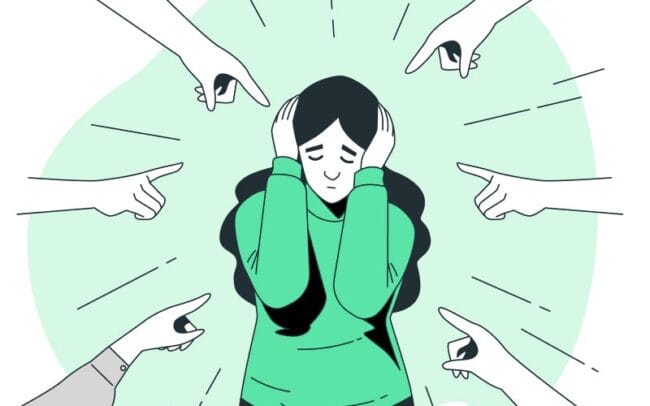
illustration of woman with fingers pointing towards her representing feeling shameful

Shame Vs. Embarrassment

While related, shame and embarrassment are distinct emotions. Embarrassment often involves temporary discomfort about a specific situation without long-term effects on one’s self-worth. For instance, spilling a drink at a party might cause embarrassment. However, if it leads to thoughts like “I am clumsy” or “I’m not good enough,” it may trigger feelings of shame.

Situations like being criticised at work, experiencing a breakup, or not meeting societal beauty standards can also lead to negative self-perception and shame. Understanding these differences can help you to navigate your emotional experiences and prevent self-destructive behaviours.

The Evolutionary Roots of Shame

According to research by Sznycer et al. (2016), shame evolved as a defence mechanism to protect individuals from social rejection. In ancient times, being valued by the community was crucial for survival. As a powerful emotion, shame encourages individuals to conform to social norms and maintain positive relationships.

Today, while the environment has changed, the emotional response remains. However, modern pressures—such as social media comparisons—can intensify feelings of inadequacy. This negative self-talk can make it more challenging to navigate negative thoughts and emotions healthily.

When Is Shame Not Helpful?

Shame becomes toxic when it leads to excessive self-criticism, causing toxic shame. This often involves self-destructive behaviours and can result from early life experiences such as trauma, abuse, or emotional neglect. Toxic shame leads to a belief that one is fundamentally flawed, unlovable, or incapable of being a better person.

Managing Toxic Shame

If your feelings of shame become overwhelming or difficult to manage, professional help may be necessary.  Cognitive behavioural therapy (CBT) can help challenge negative beliefs and reframe negative self-talk. If self-help techniques or confiding in a trusted friend don’t alleviate the feelings, reaching out to a therapist or joining a safe space like a support group may provide relief.

How Shame Affects the Body and Mind

Shame triggers a series of physiological and psychological responses:

  • Emotional well-being: Feelings of shame can lead to chronic stress, which affects your emotional and mental health. You might experience a feeling of inadequacy, a desire to hide, or even inner critical thoughts that negatively impact your sense of self-worth.
  • Physical symptoms: Shame can activate the body’s stress response, causing physical health issues such as an increased heart rate, elevated blood pressure, muscle tension, sweating, and digestive problems.
  • Mental health issues: Prolonged shame weakens the immune system, making individuals more susceptible to illness while also affecting mental health, concentration, and decision-making.

Six Effective Ways To Manage Shame

Overcoming shame involves implementing practical, healthy strategies:

  1. Challenge Negative Thoughts: Utilise CBT techniques to challenge negative self-perception. For example, replace “I’m a complete failure” with “I am on a journey of personal growth.”
  2. Practice Self-Compassion: Be kind to yourself. Treat yourself with care and engage in activities that enhance your emotional well-being, like journaling or spending time in nature.
  3. Learn and Grow: Consider mistakes to be an opportunity for growth. View shame as a tool to realign your behaviours with your values, thus becoming a better person.
  4. Mindfulness and Breathing Techniques: Practice mindfulness and use grounding exercises or breathing techniques to manage your emotional responses. These methods help calm the central nervous system and bring balance.
  5. Positive Self-Talk: Focus on affirmations that build your positive self-image. Journalling is an effective way to track your achievements and strengths.
  6. Talk About It: Opening up about feelings of shame with a trusted friend, a support group, or a professional can reduce isolation and help you gain perspective. If you’re looking for one-to-one support, my counselling and coaching services offer a safe space to explore and reframe these feelings.

man with arms outstretched representing freedom from feelings of shame

To Conclude

Shame is challenging, but it doesn’t have to control your life. By understanding its roots and practising effective ways to manage it, you can reclaim your sense of self-worth and cultivate a positive self-image. Embrace your personal development journey by building emotional well-being, practising self-compassion, and overcoming shame’s negative grip.

If you’re ready to address toxic shame and achieve personal growth, consider seeking professional support through therapy or coaching. Take the first step toward living with confidence and peace. Book a free discovery call today.

References:

Sznycer, D., Tooby, J., Cosmides, L., Porat, R., Shalvi, S., & Halperin, E. (2016). Shame closely tracks the threat of devaluation by others, even across cultures. Proceedings of the National Academy of Sciences, 113(10), 2625–2630. https://doi.org/10.1073/pnas.1514699113

Why Do I Get So Angry? Anger Management Strategies That Work

Why Do I Get So Angry? Understanding and Managing Anger

Anger is a natural and universal emotion, but when it feels overwhelming or uncontrollable, it can take a toll on your well-being and relationships. If you find yourself wondering, “Why do I get so angry?” you’re not alone. Many people struggle with anger, but the good news is that it can be managed effectively.

What is Anger?

Anger is your body’s way of alerting you to a perceived threat, injustice, or frustration. It can be a useful signal that something needs attention, whether it’s a personal boundary being crossed or an ongoing stressor in your life.

When managed well, anger can help you set boundaries, advocate for yourself, and take action in challenging situations. It can even drive positive change, making you more resilient and motivated to stand up for your values. However, when anger spirals out of control, it can negatively impact your relationships, work, and mental health

Why Do I Feel So Angry?

Anger isn’t just about what’s happening in the moment. It can be influenced by a combination of personal experiences, neurological factors, and underlying emotions such as stress, anxiety, or frustration. Factors that may contribute to increased anger include:

  • Past experiences and learned behaviours
  • Neurodevelopmental conditions such as ADHD or autism
  • Chronic stress or unresolved trauma
  • Physical health issues or hormonal imbalances
  • Feeling unheard, disrespected, or powerless

Understanding your personal triggers is key to managing anger more effectively.

How Anger Affects the Body

When anger strikes, your body enters a heightened state of arousal, activating the ‘fight-or-flight’ response. This survival mechanism releases stress hormones like adrenaline and cortisol, leading to physical symptoms such as:

  • Increased heart rate and blood pressure
  • Muscle tension and clenched fists
  • Sweating and flushed skin
  • Restlessness or difficulty concentrating
  • Difficulty sleeping

These responses are helpful in real emergencies, but when they occur frequently due to everyday frustrations, they can lead to chronic stress, anxiety, and even long-term health issues.

Physical Exercise can help you to release anger, and it is good for your overall mental health.

How Do People Express Anger?

People express anger in different ways, often without realising it. Recognising your patterns can help you take control before anger escalates. Some common expressions of anger include:

Verbal Expressions

  • Raising your voice, shouting, or swearing
  • Using sarcasm or passive-aggressive comments
  • Blaming others or making accusations
  • Making threats or ultimatums

Non-verbal and Behavioural Expressions

  • Tense body language, clenched fists, or frowning
  • Withdrawing or refusing to communicate
  • Slamming doors, throwing objects, or physical aggression
  • Engaging in self-destructive behaviour, such as over-eating or substance use

The Impact Of Uncontrolled Anger

Unchecked anger can have serious consequences for your well-being and relationships. Over time, it may lead to:

  • Physical health issues such as high blood pressure and a weakened immune system
  • Mental health struggles including anxiety, depression, and low self-esteem
  • Relationship breakdowns due to conflict and poor communication
  • Workplace difficulties affecting job performance and professional reputation

How to Manage Anger Effectively

Learning to manage anger doesn’t mean suppressing it, it’s about expressing it in a way that is healthy and constructive. Here are some strategies that can help:

Identify Your Triggers

Start by recognising what situations or thoughts tend to trigger your anger. Are there recurring patterns? By identifying these triggers, you can begin to address them before they escalate.

Take a Step Back

When anger starts to build, step away from the situation if possible. A short break can help you calm down and respond more rationally.

Use Relaxation Techniques

Deep breathing, progressive muscle relaxation, and visualisation can help reduce the intensity of anger. Before reacting, try taking slow, deep breaths and counting to ten. If you’d like more strategies, my blog on Grounding Techniques offers practical ways to stay calm and in control.

Challenge Negative Thoughts

Cognitive restructuring involves changing the way you interpret situations. Instead of thinking, “This is so unfair,” try shifting your perspective to, “I can handle this calmly and find a solution.”

Practice Effective Communication

Use “I” statements to express your feelings without blaming others. For example, instead of saying, “You never listen to me!” try, “I feel frustrated when I don’t feel heard.”

Engage in Physical Activity

Exercise is a great way to release built-up tension and lower stress hormones. Activities such as walking, running, or even hitting a punch bag can be effective outlets.

Find Healthy Outlets for Your Emotions

Creative outlets like writing, painting, or playing music can help you express your feelings in a non-destructive way.

Create an Anger Management Plan

Develop a personalised plan with coping strategies you can use when anger arises. Having a clear plan makes it easier to respond calmly in the moment.

When to Seek Professional Support

If anger is affecting your daily life, relationships, or overall well-being, professional support can make a difference. Counselling, coaching, cognitive behavioural therapy (CBT), and hypnotherapy can provide tools to help you manage anger more effectively and improve emotional regulation.

As a therapist, I support clients in developing personalised anger management strategies to regain control over their emotions and build healthier relationships. If you’re ready to take the next step, visit my services page to learn more about how I can help.

Final Thoughts

Anger is a natural emotion, but how you handle it shapes your well-being. By understanding your triggers, using effective coping strategies, and seeking support when needed, you can turn anger from a destructive force into a tool for positive change.

If you’d like to explore support options for managing anger, get in touch to book a discovery call. Managing anger is possible, and you don’t have to do it alone.

Schedule Your Free Discovery Call

Counselling, ADHD coaching, and self-paced ADHD courses to help you feel calmer, clearer, and more confident. Book a free 20-minute Zoom discovery call anywhere in the UK.

SCHEDULE A Free DISCOVERY CALL